


Head & Neck Écorché: Topical Steroid Withdrawal (TSW) Syndrome
Project Type
Media
Audience
Wax Modelling
Modelling Wax, Oil Paint
Medical Students, Patients
A wax model depicting Topical Steroid Withdrawal (TSW) Syndrome, a skin condition that is frequently undiagnosed or misdiagnosed due to the manifestation of symptoms similar to other inflammatory skin conditions. The underlying vasculature was modeled to illustrate the dense network of blood vessels that contributes to skin redness during inflammation.
Research & Planning
Preliminary research was done to get a better understanding of TSW. I sketched out the different sides of the model, with half of the head depicting the skin condition while the other half shows an écorché with the major blood vessels of the face. Symptoms of TSW that I planned to show included skin redness, dry and flaky skin, swelling of the skin and hyperpigmentation.


Sculpting: Eyes
I first began by filling the orbits with wax and placing the eyeballs in position, followed by creating the palpebral part of the orbicularis oculi muscle. I then secured the skull to the base using epoxy putty.
Sculpting: Muscles of Mastication
Next, I sculpted the temporalis and masseter muscles, and textured the muscles on the left side only, as the right side will be covered with skin.


Sculpting: Muscles of Facial Expression
I attached a block of wax for the nose, sculpted the general shape and smoothed it out, then carved in the nasal cartilages. I also added details to the alar fibrofatty tissue using a round-tip carving tool.

Next, I attached the nasalis, levator labii superioris aleque nasi, buccinator, levator anguli oris, levator labii superioris, and orbicularis oris muscles.

Superficially, I added the zygomaticus major, zygomaticus minor, and risorius muscles, and blended the fibres in with the orbicularis oris.

Next, I added the mentalis muscle and used a pointed tip carving tool to sculpt the small fibres that would connect to the skin of the chin. I then added the depressor labii inferioris and depressor anguli oris muscles and blended the fibres with the orbicularis oris muscle. Following that, I added the corrugator supercilii muscle.

Over top of the corrugator supercilii, I added and textured the frontalis muscle and posteriorly, I added the occipitalis muscle (not pictured).
Sculpting: Neck
Moving on to the neck, I attached a sheet of wax to the base of the mandible/floor of the mouth to create the mylohyoid muscle, then attached the two bellies of the digastric muscle.
In place of the cervical vertebrae, I just taped up some aluminum foil to the base, added a layer of wax to cover it, then proceeded to attach two tubes for the oesophagus and trachea. I added the hyoid bone and thin strips were rolled out for the cricoid and tracheal cartilage.
I also sculpted the thyrohyoid muscle and textured the thyrohyoid and cricothyroid membranes. The thyroid gland was sculpted over top of the trachea.
Next, I sculpted the sternohyoid (cut), omohyoid (cut), stylohyoid, sternocleidomastoid, and trapezius muscles. To hold everything in place and make it more presentable, I added a sheet of wax underneath the neck.


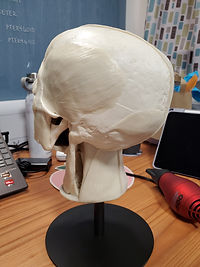


Sculpting: Skin
For the skin, I worked in sections, adding small pieces of wax starting from the buccal region. I slowly built up the layers until I reached the desired facial structure.
To create the texture of dry skin, I simultaneously used a hair dryer to soften the wax while using the rough side of a dish sponge to repeatedly dab the skin until I achieved the desired texture.
Sculpting: Blood Vessels
I first started sculpting the arteries by mixing some wax with crimson red oil paint and rolling out thin strips of wax. For the veins, I used a mixture of phthalo blue and crimson red to achieve a deep indigo colour.
To finish off, I sculpted the parotid gland and duct, and attached the ears.


Painting
I painted the muscle side first–it was a bit challenging to make sure that every nook and cranny was covered in paint with all the blood vessels but I was able to wipe off excess paint using a little bit of zest it oil paint dilutant and a Q-tip.
For the skin, I used the soft side of the dish sponge to dab and mix bits of red (majority), yellow, and blue.
Details
For the finishing touch of recreating the flakiness of dry skin in TSW, I first used a dish sponge to lay down a thin layer of white speckles all over the skin, concentrating on areas that would be drier than others.
I then added some hyperpigmentation using a mixture of crimson, burnt umber, and white diluted oil paint and further using the sponge to lightly blend it into the skin.
For the texture, I ripped out tiny pieces of a white translucent plastic bag and strategically placed them around the perimeters of hyperpigmented spots, giving off the appearance of flaky, shedding skin.
